How to Create Brand Demand, Not Just Capture It On Amazon
Often, when we audit or inherit an account after an agency or in-house team, we find the same starting point: almost all the campaigns are built around capturing demand that already exists in search.
That is not a criticism. Most brands are rightly protective of ROAS, and most teams are working within guardrails set by stakeholders. In many cases, search-led capture is exactly the right place to start because it forces discipline, prakeholders. In many cases, search-led capture is exactly the right place to start because it forces discipline, protects margins, and creates the confidence needed to justify further investment.
The issue is what happens next. If last-touch ROAS is the main performance indicator, it is understandable that the strategy stays search-led, but it can limit how quickly you unlock the next stage of growth. You typically then end up fighting harder for the same pool of shoppers, usually with rising CPCs and increasingly marginal gains.
Demand growth is the work that increases brand awareness; it shows up downstream as stronger branded search, better conversion rates, and improved efficiency in your search-led campaigns, because shoppers arrive warmer and more familiar with your products.
At Market Rocket, we do not lead with demand creation in every case, but it often becomes an important part of the growth conversation with our clients. The benefit is not always immediate in reporting, but it shows up over time through stronger efficiency and brand presence on and off Amazon.
Search Capture Vs Demand Creation: The Practical Difference
Demand Capture (Lower Funnel)
When we talk about demand capture, we are referring to Amazon Sponsored Ads activity that shows up when the shopper already has intent and is close to a decision.
Practically, this is your search shelf: high-intent keywords, competitor and adjacent ASIN targeting, and placements that sit closest to the purchase moment. This is where Sponsored Products tends to do most of the heavy lifting, supported by Sponsored Brands when it’s built to drive immediate traffic to a hero SKU, a collection, or the Store. Sponsored Display can sit here too when it’s used for product targeting and defensive placements, rather than audience prospecting.
The reason it looks “clean” in reporting is simple: it’s closest to checkout. Click-based, last-touch attribution will naturally give these campaigns most of the credit because they are often the final step before purchase.
Demand Creation (Upper Funnel)
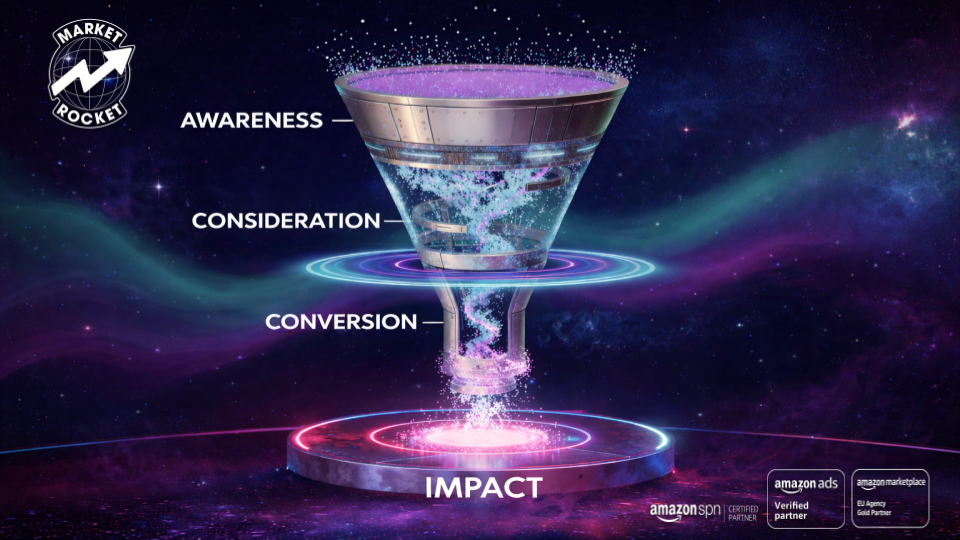
Demand creation sits earlier in the journey. You’re investing in familiarity and preference so that when the shopper is ready to buy, they can find your brand or product by name. The payoff typically shows up downstream: more branded demand (on Amazon and off Amazon), and improved conversion efficiency in your Amazon search-led campaigns.
On Amazon, demand creation is typically driven by video and audience-led activity that builds familiarity before purchase intent peaks. In practice, that includes Sponsored Brands (especially video), Sponsored Display audiences, DSP prospecting, and, where it fits the brand and budget, Sponsored TV and streaming inventory. That demand is then captured later through retargeting (Sponsored Display and DSP) and your core search-led conversion campaigns (Sponsored Products and high-intent Sponsored Brands).
Demand creation is not limited to Amazon. Off-Amazon activity can have a very real impact on Amazon sales because shoppers often discover on one channel and then validate and buy on Amazon. Google, Meta, TikTok, creators, social campaigns, PR, affiliates, sampling, and retail moments all build familiarity and intent, which tends to translate into stronger branded search and higher conversion rates once shoppers reach Amazon.
In summary:
- Capture wins clicks from existing intent.
- Demand creation increases future intent and shifts it more towards your brand.
Why Demand Growth Matters For Both New Brands & Category Leaders
Category Leaders
Being number one is not the end state. It just changes the game.
Leaders usually face three realities:
- The category does not stand still. Competitors reposition, new use cases emerge, and adjacencies expand. If you only defend the search shelf, you are reacting rather than shaping.
- Incremental share becomes expensive. Once you dominate the obvious targets, the next slice of growth often comes with higher auction pressure and less forgiving CPC economics.
- Conversion becomes the real moat. Lots of brands can bid. Far fewer can sustain conversion at scale. Store journeys, video, A+ content, and a clear range narrative protect conversion rates, and conversion rates protect profitability.
For category leaders, demand growth reduces the need to keep paying more for incremental shelf share, and helps the brand stay ahead by increasing total demand, not just competing harder for what already exists.
Launching Brands With Low Branded Search
The main challenge for newly launched brands is clear: Amazon does not owe a new brand visibility.
If branded search is low, you are competing in a category where shoppers already have default choices. If the strategy is only search-led early, you often see the same thing happen: CPCs are expensive, conversion rates are softer, and spend gets constrained because early ROAS optics erode channel confidence.
This is exactly where demand creation earns its place: it takes some of the burden off cold search acquisition, helps brands build recognition faster, and gives the account a better foundation for search efficiency to improve as the launch matures.
Our Recommended Demand-Creation Stack on Amazon
This is not just “switching on awareness”. It is about sequencing activities properly so there is less reliance on a single touchpoint to do all the work, and to enable the demand we create to be captured further down the funnel.
1) Video-Led Discovery
Video does more persuasion before the click than most search-led formats.
In most cases, Sponsored Brands Video is the most practical place to start because it sits close enough to search to remain commercially accountable while helping build familiarity much earlier than a standard search ad. It can make the brand feel established faster, which matters especially in crowded categories or at premium price points.
For larger budgets and/or broader reach, this can extend into DSP video and Streaming TV / Sponsored TV as part of the same demand-creation layer, provided the creative and measurement are in place.
2) Audience Building & Re-Engagement
Once visibility starts to build, the next question is: are we building a warm audience, or are we paying for first touches over and over again?
This is where Sponsored Display audiences and Amazon DSP become important. They allow us to build and re-engage audiences using Amazon signals, then sequence messaging based on where the shopper is in the journey (for example, category browsing, product views, Store visits, and previous purchases, depending on format and eligibility).
That is the difference between renting traffic and building a compounding pipeline.
3) Store Journeys & Merchandising
Upper-funnel traffic behaves differently from search capture traffic. Browsing and comparison are more common and reassurance is typically needed before purchase.
If you send colder traffic straight to a single PDP (product detail page) with no broader journey around it, you can waste a lot of the reach you have paid for.
For broader discovery traffic, we will often route into the Brand Store because it can do more of the selling work across the range: navigation, proof points, education, and clearer “what next” paths that support cross-sell and basket growth.
4) Conversion Capture
Once the audience is warmed up, we shift the emphasis to conversion.
This is where Sponsored Products does most of the heavy lifting, supported by Sponsored Brands for branded defence and range discovery, plus Sponsored Display for retargeting and product/contextual targeting. DSP can also sit here for lower-funnel retargeting and recovery if the scale and economics justify it.
This is where the commercial payoff becomes more visible. Not always in the same campaign that created the demand, but in the system as a whole.
5) Measurement & Budget Discipline
This is the part that decides whether a good strategy gets enough time to work.
If demand-creation activity is judged solely by last-touch ROAS, it is very easy to cut investment before the downstream effect has had time to materialise. We would usually expect the early movement to show in metrics like branded search trends, Store engagement, and conversion rates before the ROAS improves.
That is why we look at this on two levels:
- Format-level performance (to keep spending accountable)
- System-level impact (to see what the full stack is doing across the journey)
If a brand is investing seriously in full-funnel activity, we do not want to judge the strategy only on whichever campaign got the final click.
That is where Amazon Marketing Cloud (AMC) becomes valuable. We use it to look at how shoppers are moving through the journey across formats, for example which combinations of exposure are showing up before conversion, how long it takes people to purchase, where retargeting is helping, and where spend is creating influence that standard last-touch reporting does not fully credit.
The benefit is not just better reporting. It is better decision-making. It helps us allocate budget with more confidence across discovery, re-engagement, and conversion activity, because we can see more clearly what is assisting sales, not just what is closing them.
January 2026: Amazon Store View Attribution Change
Amazon introduced a shopping-signal-enhanced last-touch attribution model for Amazon Store ads, effective 1 January 2026, across selected marketplaces (including the UK), with “all views” metrics still available as a separate lens for eligible campaigns.
In plain English, your reported numbers can move because the attribution model changed, not because commercial performance changed. If you are investing in view-based formats, you need measurement discipline so you do not optimise off a reporting artefact.
Where Streaming TV / Sponsored TV Fits
Streaming TV should be treated as the start of a sequence, not a standalone strategy. Its role is to build reach and familiarity at scale. The next step is to pull those audiences into stronger mid- and lower-funnel paths through Store visits, retargeting, and search-led conversion campaigns.
The logic stays the same: reach first, sequence second, capture last.
Product Cycle Length Changes How Demand Creation Should Be Planned
Not all demand creation should be implemented with the same strategy, and one of the biggest variables is product cycle length.
For short-cycle products (for example beauty, consumables, supplements, or anything with a relatively frequent repurchase window), demand creation can pay back faster because the gap between discovery and purchase is usually shorter, and repeat purchase behaviour can start compounding earlier. In those categories, you can often see the downstream impact sooner through branded search growth, stronger retargeting performance, and improving conversion efficiency, assuming the retail fundamentals are in place.
For longer-cycle products (for example higher AOV or more considered purchases, or products people simply do not buy very often), demand creation is still important, but expectations need to be set differently. The consideration window is longer, the path to purchase is less linear, and the return rarely shows up neatly in short-term last-touch ROAS. In these cases, the early signals are more likely to be things like branded search trend, audience growth, repeat visits, and stronger conversion when shoppers come back later.
The practical point is that the strategy should not just match the brand stage, it should also match the product cycle. Shorter-cycle products can often show the downstream payoff faster. Longer-cycle products usually need more sequencing, more patience, and tighter measurement discipline.
This is also why LTV (lifetime value) matters so much in demand growth decisions, because the economics look very different when a product is likely to be bought again in 30 to 90 days versus once or twice a year.
Costs: What Brands Often Misjudge
Upper funnel is not automatically “more expensive”. It is just priced differently, and the return does not always show up where people expect it.
- Search-led activity is typically CPC. You pay for the click.
- Upper-funnel activity is often bought on a CPM or vCPM basis. You pay for impressions (or viewable impressions), not clicks.
So yes, cost lands upfront. However, the payoff often appears later, and it often appears in other campaigns.
The biggest failure with upper funnel campaigns is running reach without building the conversion catchment behind it: limited retargeting, weak Store experience, weak PDP conversion, or stock that cannot support momentum. In that situation, you can create demand and still fail to convert it.
What We Track If The Goal Is Demand Growth
Commercial Impact:
- Contribution margin and profit after ads
- TACoS (ads as a percentage of total revenue)
- Total sales and unit velocity trend
- Repeat purchase behaviour, LTV and Subscribe & Save (where relevant)
Demand Creation:
- Reach and frequency
- Video engagement and completion
- New-to-brand volume and share (where available)
- Branded search trend over time
- Store traffic and engagement
Demand Harvesting:
- CTR and CVR by targeting type (keyword vs product vs audience)
- Cost per detail page view for colder traffic
- Search term mix shift over time (are you improving branded and mid-funnel performance, not just buying the same generic terms)
Investment Bands: What Becomes Possible At Each Level
Budget requirements vary by category, CPC environment, price point, and product cycle, so we never recommend one blanket number. What we do recommend is agreeing the investment band upfront, because it dictates how much of the demand system you can run at the same time, how quickly you can build momentum, and how confidently you can measure downstream payoff.
This is not only about Amazon ad formats. The investment band should cover the full demand campaign architecture, including Amazon Sponsored Ads, DSP / Streaming TV and off-Amazon activity.
Band 1: Search-Led Capture With Controlled Demand-Creation Testing
Best for cautious stakeholders, new launches that need proof, and brands rebuilding trust in measurement.
Mix (Amazon + off-Amazon):
- Sponsored Products and Sponsored Brands foundation
- Sponsored Brands Video for controlled discovery testing
- Sponsored Display retargeting for PDP and Store visitors
Off-Amazon demand creation testing, for example:
- Google brand and high-intent non-brand coverage
- Meta or TikTok creative tests to build familiarity
- Creator seeding / content that can be repurposed into ads
- Basic tracking and Amazon Attribution setup to monitor on-platform impact from non-Amazon activity
What we expect to move first:
- Store engagement
- New-to-brand metrics
- Branded search trend (even if modest)
- Conversion rate uplift in core search campaigns
- TACoS stability as total revenue grows
Band 2: Always-On Audiences With Full-Funnel Layering
Best for brands ready to grow branded demand and reduce reliance on auction-only growth.
Mix (Amazon + off-Amazon):
- All of Band 1
- Heavier Sponsored Display Audiences for prospecting and retargeting
- DSP, where commercially justified*, mainly for sequencing and tighter audience control
Always-on off-Amazon demand creation to support Amazon demand, for example:
- Meta and TikTok prospecting / creative testing
- Google activity designed to capture and create category demand
- Creator partnerships and paid amplification
- PR / campaign moments aligned to Amazon promotions, launches, or seasonal pushes
- Amazon landing strategy aligned to traffic type (PDP vs Store vs collection path)
*Commercially justified usually means:
- Running prospecting and retargeting concurrently, not one at the expense of the other
- More audience control than Sponsored Display alone provides
- A clear conversion plan behind the reach (Store experience, retargeting, offer strategy, stock)
- Measured performance at system level, not just by last-touch ROAS on individual campaigns
What we expect to move first:
- Branded search growth (Amazon, and often Google as well)
- Audience pool growth and retargeting efficiency
- Store engagement and repeat visits
- Search conversion rate improvement
- Stronger efficiency in search-led campaigns as familiarity builds
The primary goal of this band is to move from isolated campaign performance to a compounding demand system, where Amazon and off-Amazon activity are working together.
Band 3: Scaled Reach Plus Sequencing For Category Leaders
Best for category leaders defending share, and brands that want to expand total category demand.
Mix (Amazon + off-Amazon):
- All of the above
- Sponsored TV or Streaming TV layered at the top of the funnel, with clear retargeting paths back into Store and conversion campaigns
- Broader DSP reach and sequencing where scale supports it
Coordinated off-Amazon demand creation, for example:
- Larger paid social / video programmes
- Creator and PR activity tied to hero products or category moments
- Cross-channel campaign planning that deliberately feeds Amazon demand
- Stronger creative refresh cadence across channels so reach quality does not decay
What we are measuring at this level:
- Share defence without relying on runaway auction costs
- Growth in branded demand and category penetration
- New customer acquisition at scale
- Downstream efficiency in Amazon search-led campaigns
- Total commercial contribution, not just attributed ROAS on top-funnel activity
The goal of this band is expanding demand around the brand, not just competing harder for the same existing search volume.
A Note on Off-Amazon Activity
Off-Amazon activity does not need to be massive to matter. Even at lower investment levels, the right creative, the right audience, and the right sequencing can improve branded search and conversion on Amazon. The difference between the bands is not whether off-Amazon is included, it is how consistently it can run, how many layers can run together, and how robustly the downstream Amazon impact can be measured.
Key Takeaway: Brands Can Rarely Optimise Their Way To Growth
Optimisation is what you do once demand exists. Growth is what you do to create more demand.
Search-led capture will always have a role. It is the key conversion layer. However, if you want scale that does not plateau, you need upstream investment that increases familiarity and consideration, then converts through sequencing. In short, upper funnel does not replace lower funnel. It makes the lower funnel perform better.
If you want to move from demand capture to demand growth, the first step is not to spend more. It is building the right sequence, the right measurement framework, and the right conversion infrastructure so the demand you create actually turns into profitable sales.
If you want a clearer view of where your Amazon strategy is currently capped, and what to layer in next, get in touch with Market Rocket at amazon@marketrocket.co.uk.

Leave a Comment