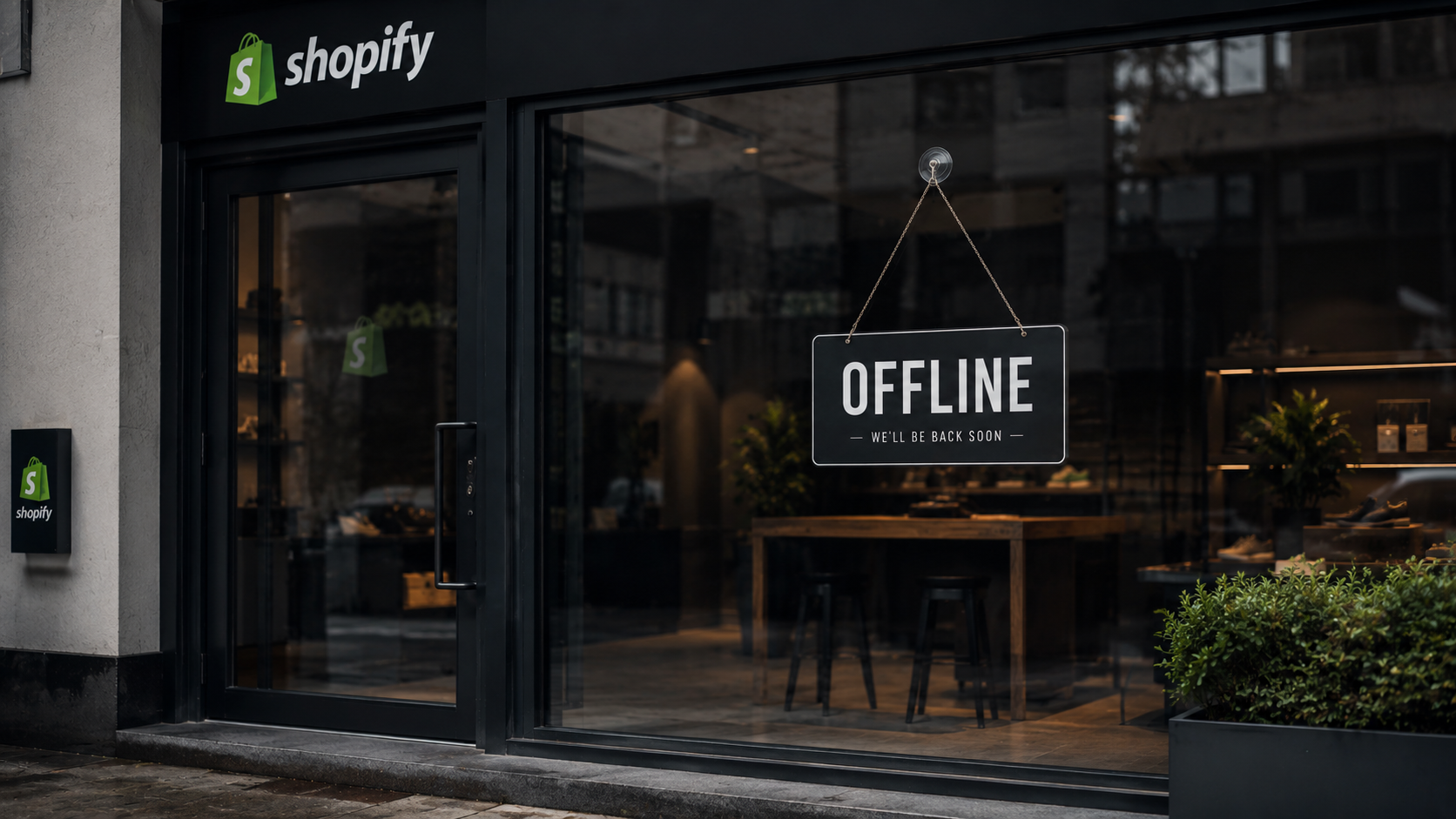
When Shopify Goes Down, So Does Your Revenue
On Tuesday 3 June 2026, Shopify suffered a service disruption that knocked out core commerce functions for merchants around the world. Storefronts wouldn’t load. Checkouts failed. Store owners couldn’t get into their admin dashboards, Retail POS systems went down in physical shops, adding insult to injury Shopify Support itself was unreachable for a period.
Shopify acknowledged the problem at 9:27 a.m. EDT and reported recovery from its mitigation efforts roughly an hour later, at 10:37 a.m. For most merchants, the disruption lasted around an hour. But an hour is a long time in ecommerce and the incident is a timely reminder of a risk many brands never think about until it bites: what happens when the platform you’ve built your business on simply stops working?
The hidden cost of an hour offline
If your storefront or checkout is unavailable, every pound you’re spending on traffic during that window is wasted. Google, Meta and TikTok don’t pause your campaigns because Shopify is down. Ads keep serving, clicks keep costing money, and visitors land on a broken page and bounce often straight to a competitor.
The damage goes beyond the immediate lost sales:
- Wasted ad spend: paid traffic arriving at a dead checkout converts at exactly 0%.
- Skewed performance data: an outage mid-campaign distorts your conversion rates, ROAS and attribution, which can lead to bad optimisation decisions for weeks afterwards.
- Customer trust: shoppers who hit an error at checkout don’t always come back, especially during a launch or promotion.
- In-store disruption: with Retail POS affected, even bricks-and-mortar sales weren’t safe.
For brands running product launches, flash sales or high traffic seasonal campaigns, even a short outage can translate into serious lost revenue and a customer service headache.
You don’t own your store, you licence it
Here’s the uncomfortable truth the outage exposes: if your business runs on Shopify (or any hosted SaaS platform), you don’t really own your website. You licence access to it. The infrastructure, the uptime, the checkout, the admin tools all of it sits on someone else’s servers, governed by someone else’s terms, and dependent on someone else’s engineering team.
That model has real advantages. Shopify is fast to launch, easy to run and handles security, hosting and payments for you. For many businesses it’s the right choice. But it comes with trade-offs that rarely get discussed at the point of sale:
- Single point of failure: when Shopify goes down, every Shopify store goes down. There is nothing you can do but wait and refresh the status page.
- No control over fixes: your developers can’t intervene. Your hosting company can’t help. You’re in a queue with millions of other merchants.
- Platform dependency: your product data, theme, apps and checkout are built around one vendor’s ecosystem, which makes leaving harder the longer you stay.
- Concentration risk: Shopify powers millions of stores, so when it stumbles, a meaningful slice of global ecommerce stumbles with it.
What are the alternatives?
The answer isn’t necessarily “abandon Shopify” it’s understanding the spectrum of ownership and choosing deliberately rather than by default.
Self-hosted open-source platforms (WooCommerce, Magento Open Source). Built on software you control, hosted where you choose. If your host has a problem, you can move. If something breaks, your developers can fix it. You own the stack at the cost of taking on responsibility for hosting, security and maintenance.
Headless commerce. Your front end (the website customers see) is decoupled from the commerce engine behind it. Even if a backend service has issues, a well-architected headless setup can keep your site online, serve cached content and capture orders for later processing.
Multi-channel resilience. Whatever platform you run, don’t put every egg in one basket. A presence across marketplaces (Amazon, eBay), social commerce and email/CRM-driven sales means an outage on one channel doesn’t switch off your entire business.
Outage playbooks. The cheapest insurance of all: a documented plan. Know how to pause paid campaigns quickly, have a status communication ready for customers, and make sure someone is monitoring platform status pages during launches and promotions.
What to do during the next outage (because there will be one)
- Pause paid traffic immediately. Every minute of spend during downtime is money on fire.
- Communicate. A quick post on social and an email saying “we’re aware, back soon” protects trust.
- Annotate your analytics. Mark the outage window so it doesn’t poison your reporting and optimisation later.
- Check everything after recovery orders, inventory sync, POS reconciliation and any abandoned checkouts worth recovering with a follow-up email.
Shopify recovered quickly this time, and credit to them for transparent status updates throughout. But the incident underlines how dependent modern ecommerce has become on a handful of platform providers. The question isn’t whether your platform will ever go down it’s whether your business is structured to survive it when it does.
If you’re not sure how exposed your store is, or you want help building a more resilient setup — from platform strategy to paid media safeguards — that’s exactly what we do. Get in touch with the Market Rocket team for a free resilience review of your ecommerce stack.
Source: Shopify status updates (shopifystatus.com), as reported by Search Engine Land, 3 June 2026.

Leave a Comment