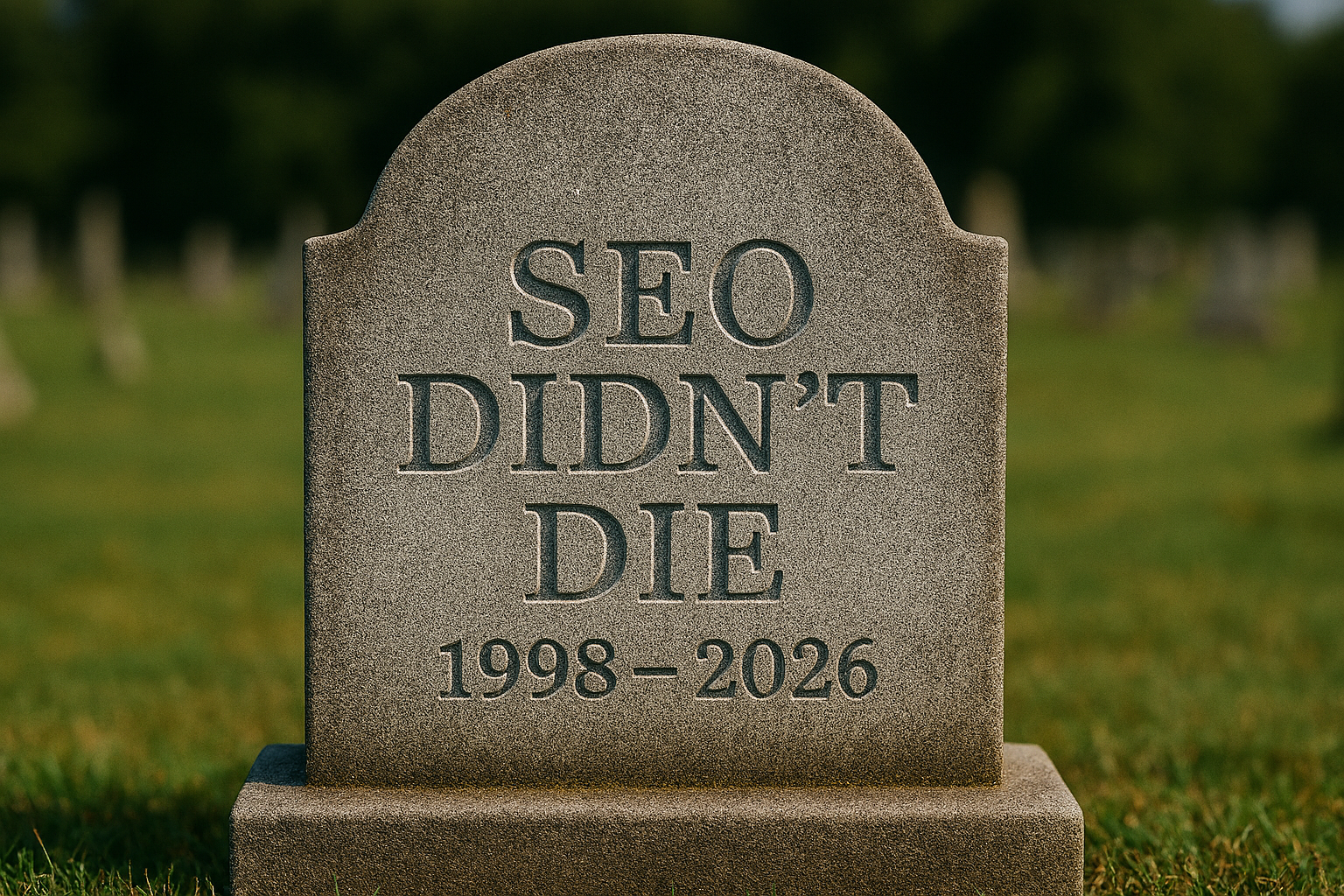
SEO Didn’t Die. It Just Got Complicated.
We’ll give you a quick insight into a conversation between Market Rocket’s SEO team and our Marketing & Strategy Director (who started SEO in 2008)
Marketing & Strategy Director:
Back in 2008 you picked a keyword, built a page, maybe thought about getting a link and waited for the magic to happen. Those were the days!
SEO Team:
Was that somewhere between Google deciding it wanted to be a chatbot and TikTok becoming a search engine.
The good old days of SEO
Let’s rewind for a second. Way back when SEO was fairly simple.
- You picked a keyword.
- You wrote a page.
- You put the keyword in the title, the H1, the footer, the alt tags and probably the meta keywords for good measure.
- You built a few questionable backlinks from directories that definitely no longer exist.
- And boom. Page one.
It was the Wild West. And honestly? It was glorious.
If you were even vaguely competent, you could rank. You didn’t need a content team, a technical audit, a product strategist and three dashboards. You just needed WordPress, a plugin, and a vague understanding of keyword density.
It felt a bit like cracking a cheat code.
Fast forward to 2026 and that version of SEO is long gone. Not because SEO stopped working but because it worked so well that Google decided to build on top of it, shake it up, spit it out and hey presto, here we are.
Is SEO dead?
Every year someone writes a blog titled “SEO is dead”. Every year SEO stubbornly refuses to die. That’s because it isn’t dead. It’s just been promoted.
The old model looked like this:
Rank, get the click, convert the customer
The new model looks more like this:
Rank, get selected as the answer, get cited by AI, get discovered on platforms, maybe get the click, then convert
Sometimes the user never even reaches your website.
They get their answer from:
Which means the real question isn’t:
“Are we ranking?”
It’s:
“Are we showing up where decisions are being made?”
Welcome to search in 2026
Search in 2026 is less like a library and more like a personal assistant.
Users don’t browse. They ask.
They want:
- The best option
- The fastest answer
- The simplest explanation
- The most trusted recommendation
And they want it now.
Google’s AI experiences have accelerated this shift. AI Overviews changed the rhythm of results. AI Mode pushes it even further. The interface now decides what the user sees first.
The zero-click world is now the default
Users increasingly get:
- Definitions
- Comparisons
- How-to steps
- Product recommendations
- Buying advice
All without clicking anything.
Your first impression is now:
- An AI summary
- A featured snippet
- A quoted paragraph
- A cited source
If you’re not in those surfaces, you’re invisible, even if you technically rank.
Customers don’t think in channels
No customer wakes up and says “Today I shall conduct an SEO journey.”
They:
- Search on Google
- Watch TikToks
- Check Amazon
- Read reviews
- Ask ChatGPT
- Click a paid ad
- Forget where they first saw you
Their journey is stitched together from dozens of touchpoints.
Which means your search strategy can’t live in a silo anymore. It has to connect to:
- Your creative
- Your positioning
- Your product pages
- Your marketplaces
- Your social presence
- Your conversion journey
Search is now an ecosystem, not a channel.
What SEO, AEO and GEO actually mean (without the jargon)
SEO: the engine
SEO is still the boring-but-essential stuff.
- Making sure your site can be crawled
- Making sure pages load fast
- Making sure content matches intent
- Making sure Google understands what you actually do
If SEO is weak, everything else struggles.
You can’t be the answer if Google can’t even read your site.
AEO: becoming the answer (Answer Engine Optimisation)
AEO is about being the page that gets quoted.
The one that shows up in:
- Featured snippets
- People Also Ask
- Voice search
- AI summaries
It’s about writing content that is:
- Easy to extract
- Easy to scan
- Easy to summarise
In other words: don’t waffle.
Put the answer first. Then explain it.
GEO: Generative Engine Optimisation
GEO is about being trusted by machines. It’s what helps you get cited in AI responses.
It’s built on:
- First-hand insight
- Real examples
- Clear opinions
- Consistent brand signals
- Proper expertise
If AEO gets you selected, GEO gets you trusted.
The Market Rocket playbook: stop choosing, start stacking
You don’t choose between SEO, AEO and GEO. You stack them.
Step one: build the engine (SEO fundamentals)
You can’t win AI visibility on a site that is slow, messy or confusing.
- Clean site structure
- Strong internal linking
- Technical health
- Pages built around intent, not just keywords
- Clear topical authority
Doesn’t sound too glamorous? Neither is being invisible.
Step two: aim the guidance system (AEO structure)
If you want to be selected as the answer, your content must be easy to quote.
- Headings that match real questions
- A direct answer immediately underneath
- Clear steps, definitions and examples
- Supporting depth that proves expertise
Think “helpful teacher”, not “rambling lecturer”.
Step three: load the payload (GEO credibility)
If you want AI to trust you, give it a reason.
- First-hand experience
- Specifics, not vague claims
- Proof, examples and insight
- Consistent brand entities everywhere
If you want to be cited, you have to be citation-worthy.
Red flags to watch for
If someone says “We’ll do SEO” as if nothing has changed, they’re living in 2015.
Other red flags:
- Content plans built on volume, not substance
- Obsession with hacks instead of foundations
- No link between content and conversion
- No plan beyond Google
That’s activity, not strategy.
Welcome to the new way of doing things, SEO didn’t die, it just got that bit more mature with a few wrinkles and much more wisdom, much like our Marketing and Strategy Director.

Leave a Comment