How AI Is Changing Google Search – And What It Means for Marketers
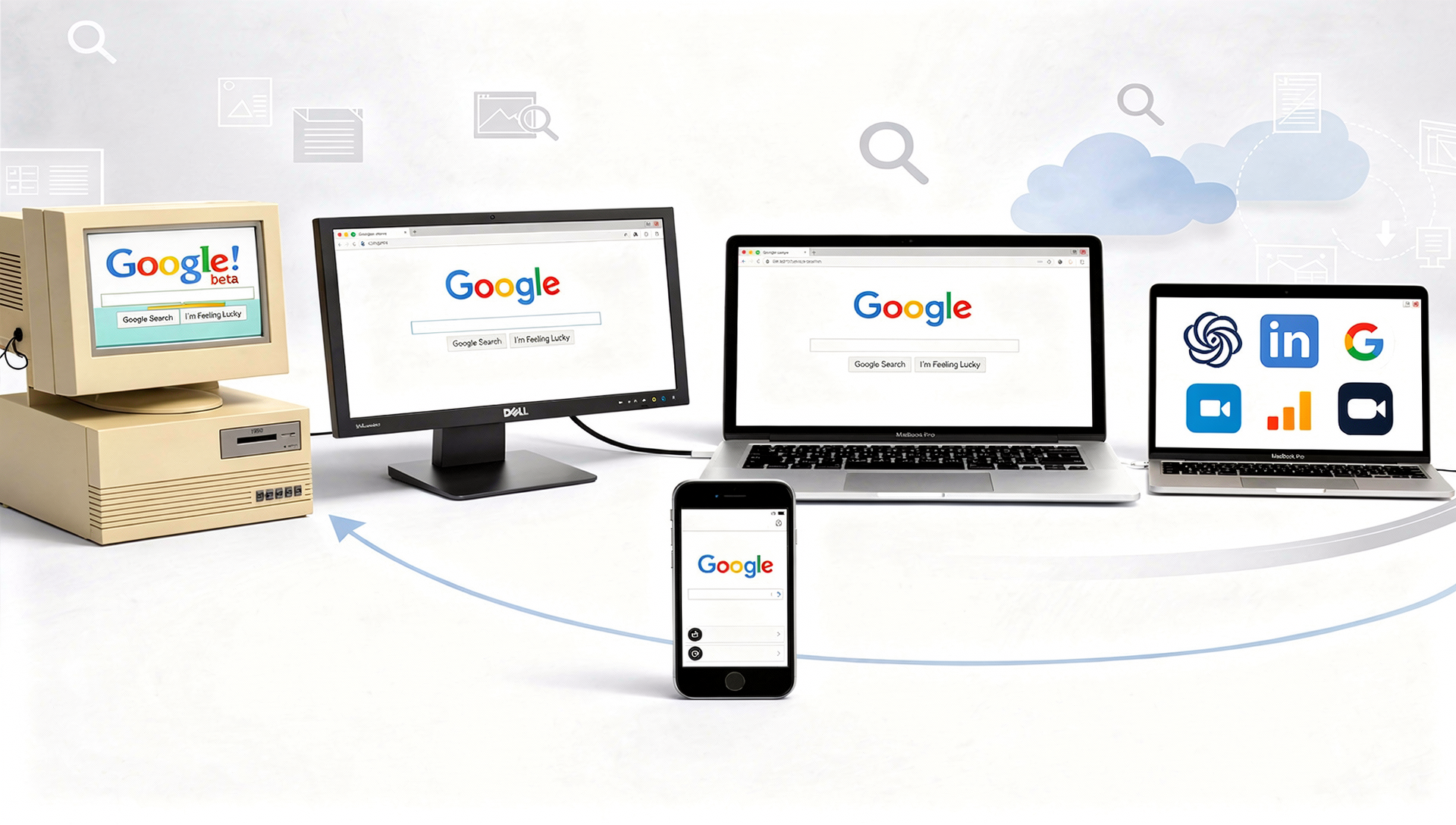
Artificial intelligence is rapidly changing how people interact with search.
Research suggests that people are asking longer questions, exploring topics across multiple tools, and encountering AI-generated summaries directly within the results page (Search Engine Roundtable, 2026).
All of these changes are prompting renewed discussion about how Google Search may evolve in the years ahead.
In a recent conversation, Google’s Head of Search, Liz Reid, explained how the company is approaching the rise of AI in search and how user behaviour is beginning to shift.
Although the current wave of generative AI feels dramatic, search itself has been evolving for years. Google has gradually introduced machine learning systems such as the Knowledge Graph, BERT, and MUM to help interpret queries, understand context, and surface more relevant information (Creative Ideaz, 2025).
From that perspective, large language models represent less of a reinvention and more of the next step in an ongoing transformation.
For marketers who rely on organic visibility, however, the implications are significant. As search experiences become more AI-driven, the way people discover and evaluate content is beginning to change.
Why Google Is Introducing AI to Search Carefully
Google Search sits at the centre of how billions of people access information, meaning that major changes are rarely introduced overnight.
Reid emphasised that Google tends to test new capabilities through controlled environments such as Search Labs before rolling them out widely.
Employing this approach allows engineers to observe how people interact with new features and refine the experience before it becomes a standard part of the search interface.
Platforms have to match this speed, as data collected from AI Overviews demonstrates that users start using new search features almost instantly as they become available. This allows Google to observe how people interact with them before expanding availability.
At the same time, behaviour can shift quickly once new tools appear.
Research suggests that AI Overviews now appear in around one fifth of Google searches in 2025, with some analyses finding much higher visibility for informational queries (Search Engine Journal, 2025).
Google’s own data has also indicated that AI-assisted search is encouraging users to ask longer, more detailed questions and explore topics more deeply.
The pace of change is deliberate as new capabilities are introduced gradually while maintaining the reliability that users expect from search.
It has become one of the internet’s most trusted features, and so any major evolution needs to preserve that trust.
Gemini vs Search: Two Different Roles in the AI Ecosystem
The growth of conversational AI has led many people to speculate whether chatbots will eventually replace search engines altogether.
Although both systems rely on related underlying models, they serve different purposes.
Tools like Gemini are primarily designed to help people complete tasks. For example, users might ask it to draft content, summarise information, generate ideas, or help solve a specific problem.
Search works differently.
Its role remains focused on connecting users with information that already exists across the web (e.g., articles, websites, research papers, videos and forums).
The two systems learn from each other as models improve, yet they address different user needs.
When someone wants a quick explanation or assistance completing a task, an AI assistant can be useful.
But when people want to evaluate sources, compare perspectives, or verify information, they often still turn to search results.
Both systems rely on similar underlying AI models, and improvements made within those models influence both experiences.
AI Agents and the Changing Web
Another technology beginning to shape discussions about the future of search is the rise of AI agents that are capable of carrying out tasks or gathering information on behalf of users.
As many of us have experienced, they are capable of browsing multiple websites, gathering information, comparing products or assisting with tasks such as bookings.
While these systems continue to develop, they are likely to change how users interact with the web in the coming years.
Instead of manually opening dozens of pages or searching for multiple articles, users may rely on AI to collect and organise information first.
However, automation does not remove the need for original sources.
People still want to verify information, understand where it came from and hear directly from human experts, publishers and creators.
AI systems ultimately depend on the open web as the source of that knowledge.
In this sense, the rise of AI agents resembles previous platform shifts, such as the transition to mobile browsing.
The way people access the web may evolve, but the web itself remains the foundation of how information is shared online (McKinsey, 2025).
Personalised Search and Trusted Sources
Another trend beginning to emerge is the growing role of personalisation in search.
Google has already explored concepts such as “Personal Intelligence”, which point toward search experiences that adapt more closely to sources that individual users trust.
This suggests that while AI shapes discovery, human trust still plays a central role.
For example, results could prioritise publications someone already subscribes to or highlight websites they visit regularly.
As the amount of online content continues to expand, this type of personalisation filtering may become increasingly important as it provides sources that are both relevant and credible.
While AI is changing how discovery happens, trust still plays a central role in how people evaluate information online (Google Search Central, 2025).
Quality and Credibility in an AI-Generated Web
One of the biggest challenges generative AI has amplified is the speed at which low-quality content can now be produced.
Spam and thin content have existed online for years, but now automation simply makes it easier to generate large volumes of it.
As a result, search engines have spent decades developing systems to identify these patterns and prioritise more useful information. Those systems continue to evolve as new forms of automated content appear.
At the same time, search is becoming better at interpreting multiple types of media.
Recent improvements in multimodal AI mean that search engines can increasingly analyse video, audio and visual content alongside traditional text.
This reflects a broader shift in how people actually consume information online today.
Younger audiences, in particular, often research topics through a mix of forums, creators, podcasts and short-form video rather than relying solely on written articles (Search Engine Land, 2025).
In response, search engines are adapting to surface valuable insights from a wider range of formats and communities.
Why AI Is Expanding the Search Ecosystem — Market Rocket’s Take
In practice, a typical research journey online rarely happens in one place.
Many people now move between multiple tools while researching.
Someone might begin with a chatbot to understand a topic, switch to Google to find credible sources, and then check discussions, videos or reviews to see how real people are talking about it.
Google reports that AI-driven search features are encouraging this behaviour, helping users ask more questions and explore topics in greater depth (Google, 2023).
Rather than replacing search, AI appears to be expanding how people discover information online.
For marketers and publishers, this signals an important shift.
Visibility will depend less on simply ranking for individual keywords and more on producing credible, genuinely useful content that remains valuable across different discovery environments.
From Market Rocket’s perspective, the long-term advantage will come from building strong brand signals, demonstrating real expertise, and publishing material that audiences trust.
In an environment where AI can generate content at scale, credibility and authority are becoming increasingly important competitive advantages.
If you have any queries about selling on Amazon or anywhere else, Market Rocket can offer you a free consultation. You can email us at amazon@marketrocket.co.uk or call 02037459090.

Leave a Comment