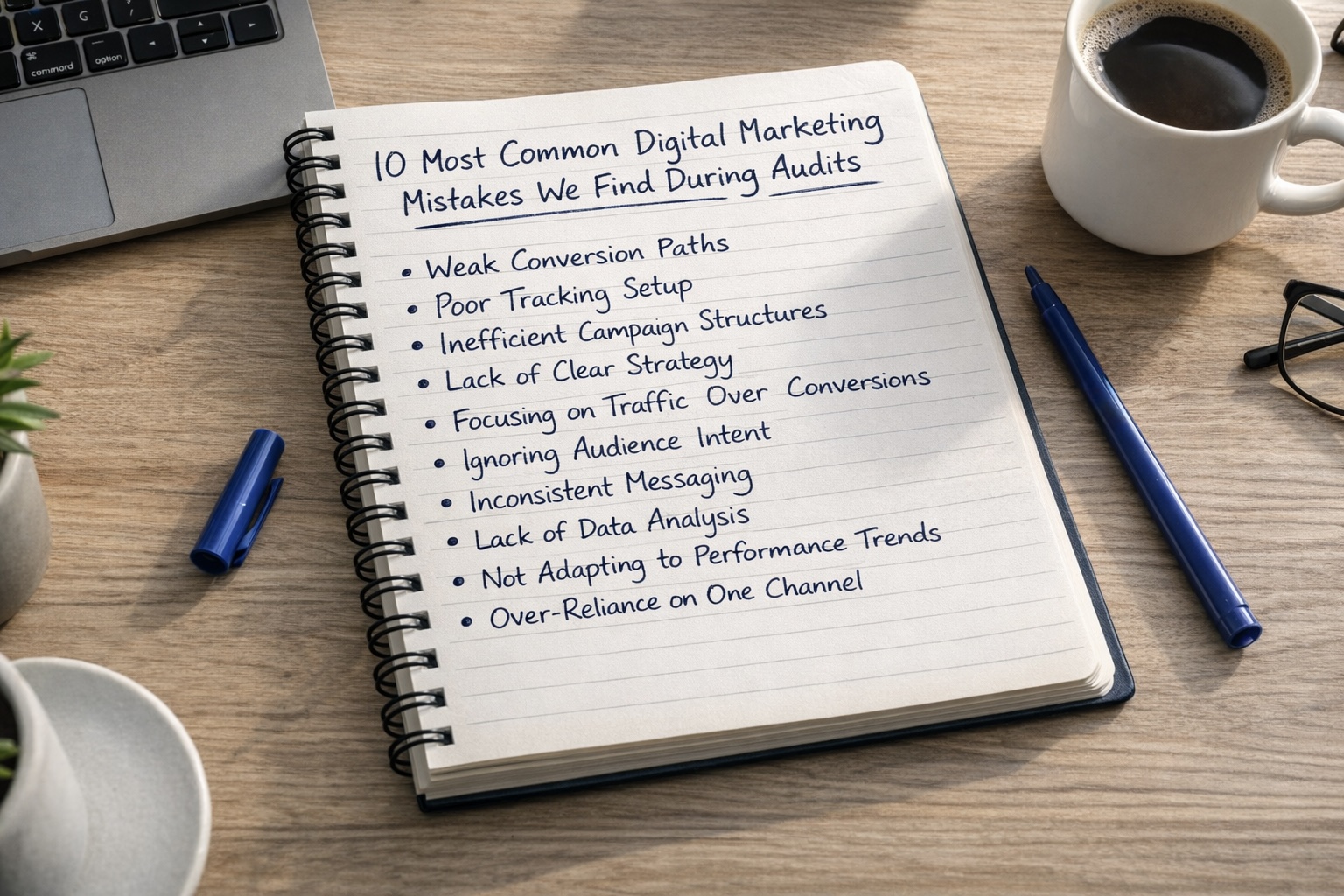
10 Most Common Digital Marketing Mistakes We Find During Audits
Digital marketing performance issues are rarely caused by one single problem. In most cases, underperformance builds up over time, driven by a series of smaller gaps across strategy, tracking, and execution.
At Market Rocket, this is something we see consistently when auditing brands. Teams are investing time and budget into their marketing, but results don’t always reflect that effort.
More often than not, performance is being held back by misaligned strategy, incomplete tracking, or inefficient campaign setup, rather than a lack of activity.
So what are the most common digital marketing mistakes, and why do they matter? Here are 10 issues we regularly uncover during audits and how they impact overall performance.
1. Weak Conversion Paths
One of the most common issues we see during audits is unclear or broken conversion journeys. Even when campaigns are driving traffic, the path from click to conversion isn’t always straightforward.
In many cases, people land on a page but aren’t given a clear next step, which makes it harder for them to take action. When the journey feels unclear or requires too much effort, a decrease in engagement becomes far more likely.
Often, this comes down to too many steps, unclear messaging, or poorly structured landing pages, all of which create friction in the user journey.
Research shows that improving conversion paths can significantly increase performance without increasing traffic (Digital Silk, 2026).
2. Poor Tracking Setup
Accurate tracking is essential for making informed marketing decisions. However, this is one of the most common gaps we uncover during audits.
In many cases, tracking isn’t set up correctly, which makes it difficult to understand what’s actually driving performance. Without reliable data, it becomes much harder to optimise campaigns effectively.
We often find issues such as missing or duplicated tracking, incorrect attribution, or incomplete data in platforms like GA4, all of which can distort performance insights.
Industry research continues to highlight that poor tracking is one of the biggest barriers to effective optimisation (Fourfold Tech, 2025).
3. Inefficient Campaign Structures
From what we see, campaigns are often set up in a way that holds back performance from the beginning.
In many cases, this comes down to issues such as:
- Overlapping audiences
- Poor keyword targeting
- Lack of segmentation
These gaps make it harder to understand what’s actually working and where budget should be allocated. As a result, the budget gets wasted, and it becomes much harder to scale performance effectively.
4. Lack of Clear Strategy
Another common pattern we see is brands being active across multiple channels without a clearly defined strategy behind it. The activity is there, but it isn’t always guided by a clear objective.
When there’s no clear direction behind posting content or running campaigns, results tend to be inconsistent and harder to improve over time. Without that foundation, it becomes difficult to understand what’s working and what needs to change.
Recent marketing insights continue to show that having a clear strategy is one of the key differences between high- and low-performing brands (Roar Digital Marketing, 2025).
5. Focusing on Traffic Over Conversions
One of the most common gaps we see is an overemphasis on driving traffic and not enough focus on what happens after the click. While increasing traffic is important, it doesn’t guarantee results on its own.
Without strong conversion optimisation, higher traffic volumes don’t necessarily always translate into revenue. If the experience after the initial click isn’t designed to convert, performance will always be limited.
This is a recurring theme across recent industry research, with reports highlighting that conversion-focused strategies are critical for turning traffic into measurable results (ASquare Solution, 2025).
6. Ignoring Audience Intent
A key issue we often come across is campaigns targeting broad audiences without fully considering intent. While this can increase reach, it doesn’t always lead to meaningful engagement.
In reality, people at different stages of the journey respond to different types of messaging, but the same approach is often applied across all stages. This makes it harder for campaigns to resonate with the right audience at the right time.
When messaging isn’t aligned with intent, engagement tends to drop and performance isn’t as strong as it could be.
7. Inconsistent Messaging
When someone clicks from an ad through to a landing page, there’s an expectation that everything will feel connected.
If the messaging, visuals, or overall tone don’t line up, the experience can quickly feel impersonal. Even small inconsistencies can make the journey less seamless and impact how much trust a brand builds.
Over time, this has a direct effect on brand performance. Research shows that consistency plays a significant role in improving both engagement and conversion rates (Billo, 2026).
8. Lack of Data Analysis
There’s no shortage of data available for digital marketers, but analysing it to improve performance will require extra attention.
Many brands are collecting large amounts of data but not always using it in the correct way to guide decisions or improve performance. Without actively analysing and applying those insights, it becomes much harder to identify what’s working.
As a result, valuable opportunities to improve performance can easily be missed.
9. Not Adapting to Performance Trends
Recent insights highlight that adapting to changing behaviour is essential for maintaining performance (ChangeScape Web, 2025).
The way consumers behave online is constantly evolving, but strategies don’t always keep up with those changes. When decisions are based on outdated data, campaigns can quickly become misaligned with how people are actually engaging.
A clear example of this is seasonal shifts like British Summer Time, where changes in routine directly impact when and how people interact with marketing. To learn more about how to adapt to these shifts in more detail, read our blog on “How British Summer Time Affects Buyer Behaviour“.
10. Over-Reliance on One Channel
Another pattern we often see is brands relying too heavily on a single channel, whether that’s paid social, SEO, or email.
This can create unnecessary risk and limits growth opportunities.
For example, if performance drops or costs increase, there’s little else to support overall results.
A more balanced, multi-channel approach typically leads to more consistent and resilient performance.
Market Rocket’s Advice
Most digital marketing issues aren’t caused by a lack of effort but because strategy isn’t aligned with consumer behaviour.
Often it’s issues such as weak conversion paths, poor tracking, and inefficient campaigns that end up holding performance back.
At Market Rocket, we approach audits with a focus on identifying these gaps and turning them into opportunities.
Need help identifying what’s holding your performance back?
We offer a free audit to uncover missed opportunities, performance gaps, and quick wins.
📩 team@marketrocket.co.uk
📞 02037459090

Leave a Comment